
Need oxygen? View oxygen generators
Nitrogen generators - on-site nitrogen production from compressed air
A nitrogen generator produces nitrogen on site, directly from compressed air. Instead of ordering cylinders or liquid nitrogen, the plant produces exactly the amount of gas it needs, at a purity matched to the process: from inerting and food packaging to nitrogen for laser cutting.
Modern Tech Group selects, installs, commissions and services complete PSA and membrane nitrogen generator systems: from the compressor through drying and filtration to the generator and nitrogen receiver. We match purity and output to the process to reduce energy consumption and the cost of each Nm³ of nitrogen. We offer Hertz Kompressoren HNG series nitrogen generators with a purity of 95 to 99,999 percent.
How a nitrogen generator works: PSA and membrane
Atmospheric air consists of approximately 78 percent nitrogen and 21 percent oxygen. A nitrogen generator separates oxygen from nitrogen and needs only clean, dry compressed air and electricity to operate. Two technologies are used.
PSA nitrogen generator (pressure swing adsorption)
A PSA nitrogen generator has two columns filled with CMS carbon molecular sieve. Under pressure, the bed adsorbs oxygen and traces of other gases, while nitrogen passes into the receiver. When the bed in one column becomes saturated, the column is depressurised, oxygen is released into the atmosphere and the second column takes over. Adsorption and regeneration alternate, ensuring a continuous nitrogen flow.
Membrane generator (hollow fibres)
In a membrane generator, compressed air flows through a bundle of thin, hollow polymer fibres. Oxygen, water vapour and carbon dioxide permeate the fibre walls faster than nitrogen, leaving a nitrogen-enriched stream at the outlet. The membrane has no moving parts or switching valves and is simple and compact.
| Parameter | PSA (CMS carbon molecular sieve) | Membrane (hollow fibres) |
|---|---|---|
| Nitrogen purity | 95 to 99,999% | 95 to 99,5% |
| Operating principle | oxygen adsorption, adsorption and regeneration cycle | selective gas permeation through fibres |
| Optimum range | above approx. 98% | below approx. 98% |
| Typical applications | laser cutting, electronics, laboratories | inerting, plastics, general applications |
The economic crossover is approximately 98 percent purity: below this, membrane technology usually wins; above it, PSA generators.
Which nitrogen purity for which application
Nitrogen purity is the most important selection parameter. It is also useful to consider residual oxygen: 99 percent nitrogen means around 10 000 ppm oxygen, while 99,999 percent means only around 10 ppm.
| Application | Typical N₂ purity | Residual O₂ (approximate) |
|---|---|---|
| Laser cutting of steel | 99,8 to 99,999% | 2000 to 10 ppm |
| MAP food packaging | 99,5 to 99,9% (E941: min. 99%) | 5000 to 1000 ppm |
| Electronics soldering | 99,9 to 99,999% | 1000 to 10 ppm |
| Plastics | 97 to 99,5% | 30 000 to 5000 ppm |
| Tank inerting | 95 to 99% | 50 000 to 10 000 ppm |
| Pharmaceuticals and laboratories | up to 99,999% | up to 10 ppm |
| Nitrogen purity | Residual oxygen |
|---|---|
| 99% | 10 000 ppm O₂ |
| 99,9% | 1000 ppm O₂ |
| 99,99% | 100 ppm O₂ |
| 99,999% | 10 ppm O₂ |
Nitrogen for laser cutting is the most common enquiry: high purity protects the cut edge from oxidation, but the exact value should be agreed with a process engineer for the material and thickness.
How much air is needed per 1 Nm³ of nitrogen
A generator does not create nitrogen from nothing: it rejects part of the feed air. The higher the purity, the more air must be compressed for each cubic metre of nitrogen.
| Nitrogen purity | Air per 1 Nm³ N₂ (approximate) |
|---|---|
| 95% | approx. 1,8 to 2,2 Nm³ |
| 99,5% | approx. 3 Nm³ |
| 99,9% | approx. 4 Nm³ |
| 99,999% | 5 to 7 Nm³ |
The conclusion is simple: higher purity requires a larger compressor, more energy and higher nitrogen costs. There is no benefit in specifying a higher purity than the process actually requires.
Nitrogen generator or cylinders and liquid nitrogen
The question "nitrogen generator or cylinders" comes down to cost per cubic metre and supply convenience. Indicative comparison:
| Nitrogen source | Indicative cost |
|---|---|
| Cylinders | typically 10 to 15 PLN per m³ |
| On-site generator | usually 0,4 to 1 PLN per Nm³ (depending on purity and energy prices) |
Savings are usually 50 to 80 percent, with a typical payback period of 1 to 3 years. Additional benefits:
- no cylinder logistics: ordering, replacement, changeover downtime or cylinder rental
- no evaporation losses typical of liquid nitrogen storage
- production continuity: nitrogen is available whenever the compressor is running.
These figures are indicative. We prepare a specific calculation for your plant based on consumption, required purity and energy prices.
Complete nitrogen system layout
A complete nitrogen production system consists of the following components:
screw compressor → air receiver → dryer → coalescing and activated carbon filtration → nitrogen generator → nitrogen receiver
Feed air should meet ISO 8573-1 class 1 for oil, with a dew point matched to the generator technology and a typical pressure of 6 to 10 bar. We build air treatment systems using components including BEKO Technologies: CLEARPOINT, DRYPOINT, BEKOMAT.
Role of air treatment components
- Coalescing filter retains oil aerosols, water and solid particles, protecting the CMS bed or membrane.
- Activated carbon filter removes oil vapour and odours that a coalescing filter cannot capture.
- Dryer lowers the dew point, as moisture shortens the life of sieves and membranes.
- Condensate drain, e.g. BEKOMAT, removes water from the receiver, dryer and filters without air loss.
- Dew point and oxygen measurement, e.g. using METPOINT instruments, enables continuous monitoring of feed air quality and nitrogen purity.
Read more about air treatment on our page compressed air filtration, and about piping on our page compressed air systems.
Can your compressor station support a nitrogen generator
A nitrogen generator uses a lot of compressed air, so we check the existing compressor station before selection:
- audit of existing compressor capacity and daily air demand profile
- check of dew point and filtration condition
- assessment of whether an additional compressor dedicated to nitrogen is needed.
An additional compressor is usually needed when the existing one operates close to full load or high nitrogen purity is required. We describe the measurements on our page compressed air audits. Remember that leaks also increase nitrogen costs, as every litre of escaping air must be compressed again. Check this with our leak cost calculator.
Lower energy consumption and costs
The largest share of generator-produced nitrogen costs is the energy needed to compress air. When selecting and operating a system, we therefore focus on several specific factors:
- Purity matched to the process, not excessive purity as a precaution. Every increase in purity means more air per 1 Nm³ of nitrogen, requiring a larger compressor and a higher electricity bill.
- No cylinder or tanker transport. On-site production eliminates deliveries and liquid nitrogen evaporation losses, reducing the CO₂ footprint associated with gas supply.
- Produce only what is needed. The generator produces nitrogen according to current demand, and the controls stop the system when demand ceases, avoiding unnecessary energy use.
Heat from the compressor supplying the generator can be recovered and used for building heating or domestic hot water. We explain the details on our page compressor heat recovery.
A leak-tight system reduces the cost of each Nm³ of nitrogen, as air lost through leaks has to be produced again. Estimate the losses with our leak cost calculator, while a complete picture of energy consumption is provided by a compressed air audit.
Hertz HNG series
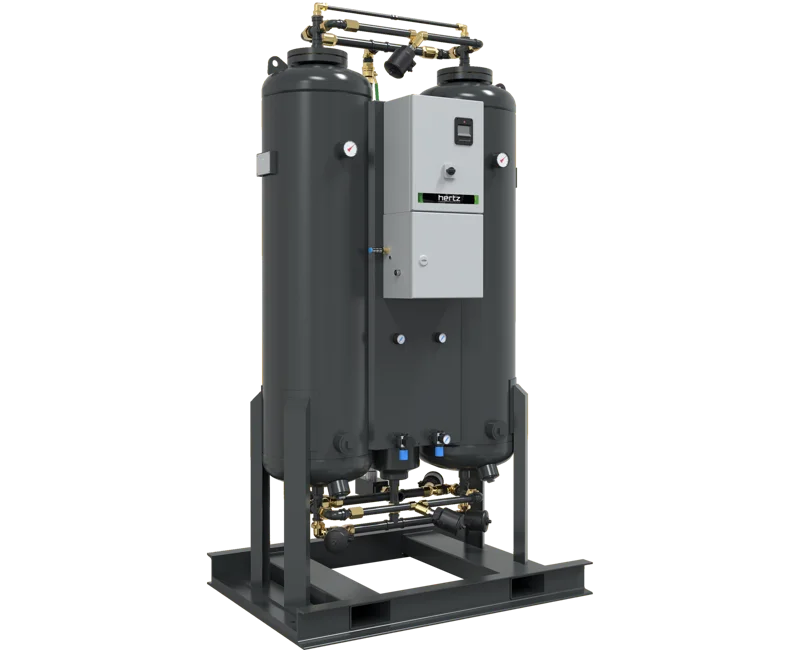
Nitrogen output in m³/h at the specified purity (manufacturer data, indicative values)
| Model | 95% | 99% | 99,5% | 99,9% | 99,99% | 99,999% |
|---|---|---|---|---|---|---|
| HNG 140 | 32 | 17 | 14 | 10,5 | 5,3 | 3,1 |
| HNG 360 | 83 | 44 | 36 | 27 | 13,6 | 8 |
| HNG 640 | 149 | 78 | 64 | 49 | 24 | 14 |
| HNG 1300 | 304 | 160 | 130 | 100 | 49 | 29 |
| HNG 3050 | 712 | 374 | 305 | 235 | 116 | 68 |
| HNG 14780 | 3450 | 1813 | 1477 | 1138 | 562 | 331 |
The full HNG series comprises 24 models. We select a generator precisely matched to your needs.
Nitrogen generator servicing
Regular servicing maintains nitrogen purity and output. Our inspections include:
- periodic inspections and checks of nitrogen purity and output
- replacement of CMS beds and membrane modules
- replacement of coalescing and activated carbon filter elements
- oxygen sensor calibration.
We service nitrogen generators from various manufacturers and air treatment systems, including during compressor and dryer inspections. See also compressed air dryer servicing.
What to include in a nitrogen generator selection enquiry
- required nitrogen purity or application
- nitrogen consumption in Nm³/h and daily profile
- required nitrogen pressure
- existing compressor and dryer
- installation location.
Nitrogen generators - frequently asked questions
Need a nitrogen generator or servicing?
Describe your application and nitrogen consumption, and we will prepare a selection proposal.
Related services
- Compressed air systemsDesign and installation of piping networks, including nitrogen systems.
- Compressed air dryersServicing of refrigeration and adsorption dryers.
- Compressed air filtrationCoalescing and activated carbon filters, ISO 8573-1 classes.
- Compressed air auditsMeasurement of compressor station output and energy consumption.
- Screw compressorsGuide to selecting a feed air compressor.
- Leak cost calculatorCalculate the cost of leaks in your network.
Contact
Need an inspection, overhaul or rental? Fill out the form - we'll respond within 24 hours.
Send inquiry
Find us on the map
ul. Słowackiego 201 26-600 Radom Mazovian Voivodeship, Poland